standards
ISO 12944 Corrosivity Categories Explained
Understand ISO 12944 corrosivity categories from C1 to CX. Learn how to select the right protective coating system for your specific environment.
ISO 12944 divides environments into six corrosivity categories (C1 to CX) and defines durability ranges (Low to Very High) to help engineers specify protective coatings that match the exact environmental stress of the asset.
Specifying the wrong protective coating system almost guarantees premature asset failure. The ISO 12944 standard eliminates the guesswork by providing a universal framework to classify the corrosivity of environments (from C1 to CX) and map them to coating durability expectations.
This guide decodes the ISO 12944 categories and helps you translate normative theory into practical maintenance specifications.
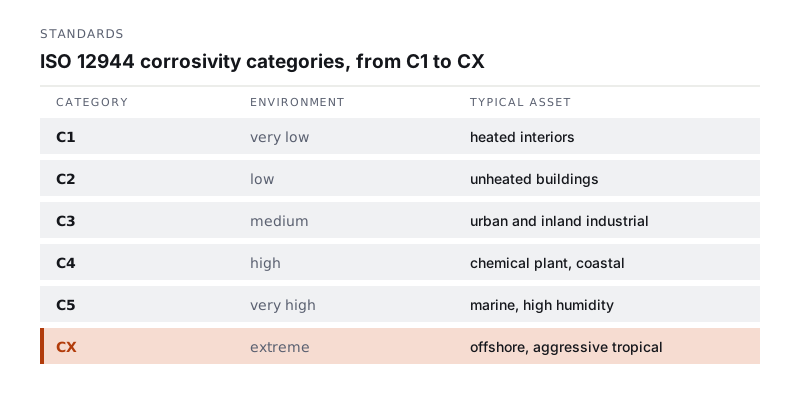
What are ISO 12944 Corrosivity Categories?
ISO 12944-2 defines environments based on their potential to cause corrosion on low-carbon steel and zinc. It considers factors such as humidity, salinity, and chemical exposure.
Corrosivity Categories Table
| Category | Corrosivity Risk | Typical Indoor Environment | Typical Outdoor Environment |
|---|---|---|---|
| C1 | Very Low | Heated buildings with clean atmospheres (offices, schools). | None |
| C2 | Low | Unheated buildings where condensation may occur (warehouses). | Atmospheres with low levels of pollution. Mostly rural areas. |
| C3 | Medium | Production rooms with high humidity and some air pollution. | Urban and industrial atmospheres, moderate sulfur dioxide pollution. Coastal areas with low salinity. |
| C4 | High | Chemical plants, swimming pools, coastal ship and boatyards. | Industrial areas and coastal areas with moderate salinity. |
| C5 | Very High | Buildings with almost continuous condensation and high pollution. | Industrial areas with high humidity and aggressive atmosphere. Coastal areas with high salinity. |
| CX | Extreme | Extreme industrial areas (mines, chemical plants). | Offshore areas with high salinity and extreme industrial areas. |
Understanding Durability Ranges
A coating’s durability is not a guarantee or a warranty; it is a technical consideration that helps the owner set up a maintenance program. ISO 12944-1 outlines four durability ranges:
| Durability Range | Expected Life to First Major Maintenance |
|---|---|
| Low (L) | Up to 7 years |
| Medium (M) | 7 to 15 years |
| High (H) | 15 to 25 years |
| Very High (VH) | Over 25 years |
The Specification Formula
To specify a coating correctly, you combine the Corrosivity Category with the Durability Range. For example, specifying a C5-H system means you are asking for a coating that can withstand a very high corrosivity environment for 15 to 25 years before requiring major maintenance.
Practical Implementation in Mining and Heavy Industry
In mining operations or heavy chemical processing, environments are rarely homogeneous. A single processing plant might have:
- C3 environments in indoor storage facilities.
- C5 environments around wet processing areas or leaching tanks.
- CX environments near coastal export terminals or under constant chemical spray.
Avoid the temptation to specify CX everywhere “just to be safe.” Over-specifying dramatically increases material and labor costs (due to required surface preparation and multiple coats). Instead, map your facility carefully and apply the right ISO 12944 category to the right zone.
Further Reading
- Check our Downtime Cost Calculator to see how specifying the wrong category affects your bottom line.
- See the comparison of SSPC Surface Preparation Degrees.
Frequently asked questions
What is the difference between C5 and CX in ISO 12944?
How long does 'High' durability last according to ISO 12944?
Can I use a C3 coating system in a C4 environment?
Sources and references
- StandardISO 12944-1:2017 — Paints and varnishes — Corrosion protection of steel structures by protective paint systems — Part 1: General introductionInternational Organization for Standardization · accessed August 29, 2026
- RegulationSSPC-SP COM-2017 — Surface Preparation Commentary for Metal SubstratesAMPP · accessed August 8, 2026
Request a technical review
Describe your equipment and the problem. You get an engineering answer, not a sales pitch.