standards
What is SSPC-SP 10 / NACE No. 2?
What near-white metal blast cleaning actually requires, how the 5% staining allowance is judged, and when SP 10 is the right call rather than SP 6 or SP 5.
SSPC-SP 10 requires removing all visible oil, grease, dust, dirt, mill scale, rust, coating and oxides from the surface. Light shadows, streaks and discolouration from residual staining may remain on no more than 5% of each unit area. It is the grade most commonly specified for immersion and severe atmospheric service.
SSPC-SP 10 is the surface preparation grade most often written into specifications for immersion service, offshore structures and severe industrial atmospheres. It sits between commercial blast cleaning and white metal — and the difference between those grades is measured in cost as much as in cleanliness.
Scope: Near-white metal blast cleaning. Defines the degree of cleanliness of a blast-cleaned steel surface, not its roughness.
What SSPC-SP 10 requires
The standard requires that the surface, when viewed without magnification, is free of all visible oil, grease, dust, dirt, mill scale, rust, coating, oxides, corrosion products and other foreign matter. Residual staining is permitted on no more than 5% of each unit area of the surface.
Two words in that sentence carry the entire specification.
Visible means assessed by eye, without magnification. It is a visual standard, not an analytical one. Soluble salts, for instance, are invisible and are not covered — they need a separate test and a separate acceptance criterion.
Staining means the light shadows, streaks or discolouration left in the pits and valleys of the steel by rust, mill scale or a previous coating. The contaminant has been removed; the colour has not. This is the specific allowance that distinguishes SP 10 from SP 5.
How the 5% allowance is judged
The 5% applies to each unit area assessed, not to the structure as a whole. An inspector does not average the cleanliness of a tank and call it acceptable — a single unit area exceeding the allowance fails.
That distinction matters commercially. On a large surface, an applicator working to an average will produce work that fails a spot inspection, and the disagreement surfaces after the abrasive has been recovered and the crew has moved on.
Note
Specify how conformance will be assessed, not only which grade applies: number of assessment points, their distribution, and who arbitrates a disputed area. A grade without an inspection method is a dispute waiting for a schedule to be under pressure.
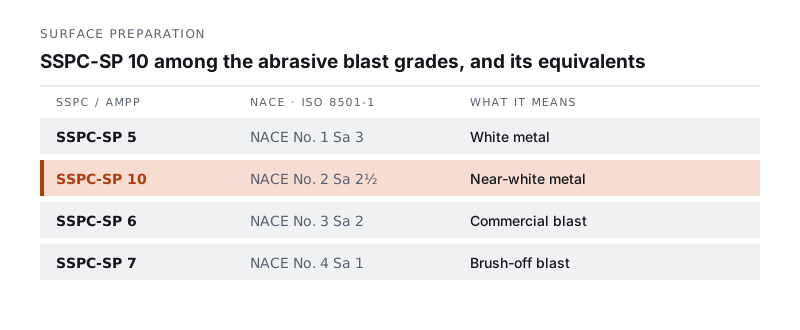
Where SP 10 sits among the blast cleaning grades
| Grade | NACE | ISO 8501-1 | Staining allowed |
|---|---|---|---|
| SSPC-SP 5 — White metal | NACE No. 1 | Sa 3 | None |
| SSPC-SP 10 — Near-white metal | NACE No. 2 | Sa 2½ | 5% of each unit area |
| SSPC-SP 6 — Commercial blast | NACE No. 3 | Sa 2 | 33% of each unit area |
| SSPC-SP 7 — Brush-off blast | NACE No. 4 | Sa 1 | Tightly adherent residue may remain |
The progression from SP 7 to SP 5 is not linear in cost. Moving from commercial blast to near-white typically means slower passes and more abrasive; moving from near-white to white metal means chasing the last shadows out of the pits, which is where the labour becomes disproportionate to the surface gained.
When SP 10 is the right specification
SP 10 is the usual choice when the coating system will be immersed, exposed to chemical splash, or installed in a high-corrosivity atmospheric category where premature failure is expensive to reach and repair.
It is over-specified for interior structural steel in a dry, heated building, where SP 6 or even SP 3 will carry the system for its intended life. Over-specifying cleanliness does not extend coating life indefinitely; past the point the coating requires, it adds cost without adding protection.
Where the choice is between several grades rather than about SP 10 itself, the full comparison — SP 1 through SP 11, with their NACE and ISO 8501-1 equivalents side by side — is set out in the comparison of SSPC surface preparation degrees.
The decision belongs to the coating manufacturer’s data sheet first. Where the data sheet calls for SP 10, applying SP 6 is a departure from the system as tested — and generally voids whatever performance the manufacturer stands behind.
Limits of use
This article describes what the standard requires. It does not replace the standard itself: SSPC-SP 10 includes reference photographs, definitions and inspection provisions that a summary cannot reproduce. Where the grade is contractual, work from the purchased document.
Cleanliness is not the whole specification
SP 10 answers one question — how clean. A complete surface preparation specification also fixes the profile range, the maximum acceptable level of soluble salts, the permitted time between blasting and first coat, and the ambient conditions during that window.
A surface blasted to SP 10 and left overnight in humid air will flash-rust and no longer meet the grade it was inspected to. The clock between preparation and coating is part of the specification, not an operational detail.
Frequently asked questions
What is the difference between SP 10 and SP 5?
What surface profile does SP 10 produce?
Is SP 10 equivalent to ISO 8501-1 Sa 2½?
Does staining mean the surface is still contaminated?
Sources and references
- StandardSSPC-SP 10 / NACE No. 2-2024 — Near-White Metal Blast CleaningAMPP · accessed August 1, 2026
- StandardISO 8501-1:2007 — Preparation of steel substrates — Visual assessment of surface cleanliness — Part 1ISO · accessed August 1, 2026
Request a technical review
Describe your equipment and the problem. You get an engineering answer, not a sales pitch.