corrosion
Anti corrosion coating types, chosen by exposure zone
Five coating families, and the order that picks between them: corrosivity category first, durability class second, product last.
You do not select a product, you select a corrosivity category and a durability class — the product follows. ISO 12944-2 fixes the category from C1 to CX, ISO 12944-1 fixes how long the system has to last, and only then does the family matter: zinc-rich primer, epoxy, polyurethane, polysiloxane or metallic.
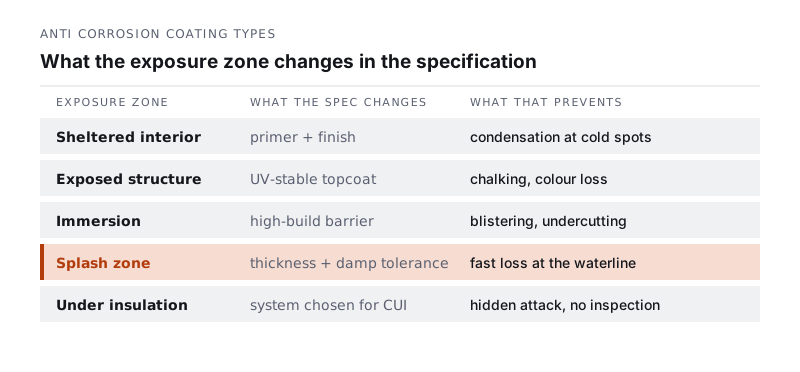
Anti corrosion coating types are chosen by exposure, not by product family. The corrosivity category comes first, the durability class second, and the system last — reversing that order is how a specification ends up naming a premium product that fails in three years.
What are the main anti corrosion coating types?
Five families cover almost all industrial work, and a real system stacks two or three of them rather than choosing one. Each family solves a different problem, which is why they are complementary rather than competing.
The table below is the shape of the decision, not the decision itself. Which member of a family, at what thickness, over what preparation grade — those come from ISO 12944-5 and from the data sheet of the product actually selected.
| Family | Role in the system | Where it stops |
|---|---|---|
| Zinc-rich primer, organic or inorganic | Sacrificial protection of the steel itself | Demands clean, profiled steel; never a finish on its own |
| Epoxy, including novolac and glass-flake | Barrier build, chemical and immersion resistance | Chalks and fades under sunlight |
| Polyurethane and polyaspartic | UV-stable, colour-stable topcoat | Thin barrier if used alone |
| Polysiloxane | Long-life topcoat in fewer coats | Tight application window |
| Metallic — galvanizing, thermal spray aluminium | Metallurgical barrier plus a cathodic effect | Capital cost and access requirements |
Why does the category come before the product?
Because the category is the only part of the problem the product cannot change. ISO 12944-2 classifies the environment from C1 to CX from what is actually present — humidity, chlorides, sulphur dioxide, wetting cycles — and that classification holds whatever is later painted onto the steel.
ISO 12944-1 then sets durability ranges for the system. Durability is a design life for planning, not a guarantee and not a warranty period, and confusing the two is a common way for a specification to promise something no supplier ever offered.
Scope: Classification of environments. Defines atmospheric corrosivity categories C1 to CX and the categories for water and soil, from measurable environmental parameters rather than from location.
Here is the position this site takes, and it is not the popular one: if you cannot commit to the surface preparation grade named in the data sheet, downgrade the system rather than the preparation. A mid-range epoxy over steel blasted to ISO 8501-1 Sa 2½ will outlive a premium system over hand-cleaned rust, and it will cost less. The product name is the part of the specification that matters least.
Polyurethane coating vs epoxy coating: when does each win?
Epoxy wins where the enemy is chemistry or water; polyurethane wins where the enemy is sunlight and appearance. They are rarely alternatives to one another — in most exposed structural work they are two layers of the same system.
- Immersion, tank interiors, buried steel — epoxy, without debate. Polyurethane has no business under water.
- Exposed structural steel, tank exteriors, colour retention — epoxy primer and build coat, polyurethane topcoat.
- Chemical splash combined with sunlight — novolac epoxy build coat, polyurethane finish.
- Return to service in cold weather — check the minimum cure temperature before anything else. That single line on the data sheet eliminates half the candidates in a Canadian winter shutdown, and it is usually read last.
What is splash zone coating, and why is it a different specification?
The splash zone is the band of a structure that is alternately wetted and dried, and it corrodes faster than the steel permanently under water. Oxygen, chlorides and mechanical action all reach their maximum in the same place — permanently immersed steel, by contrast, is starved of oxygen.
What changes in the specification, and it is more than a product substitution:
- much higher film thickness, often achieved in a single high-build or glass-flake coat rather than a multi-coat stack;
- tolerance for damp or marginally prepared steel, because blasting to a perfect grade at tide level is rarely available;
- mechanical resistance to floating debris and impact, which a thin topcoat does not have;
- inspection planned around access windows rather than around calendar dates.
Limits of use
A system qualified for immersion is not qualified for the splash zone by extension. The two exposures fail differently, and a data sheet that names one does not cover the other unless it says so.
Where mixed metals are involved
If the structure couples two different metals, the coating decision stops being a coating decision alone — the area ratio between the metals, and which one you coat, matter more than the product. Coating the active metal and leaving a single pinhole concentrates the entire galvanic current on that pinhole, which is worse than leaving it bare.
That question has its own page: galvanic corrosion in mixed-metal assemblies covers the series, the area ratio and which side to coat. This page stops at the boundary deliberately, so the two do not answer the same question in two places.
What to do next
Fix the corrosivity category first, using the ISO 12944 categories or the selector below. Write the durability class into the specification as a number of years, not as an adjective. Then choose the system — and check that the preparation grade it demands is one the site can actually deliver, using the SSPC preparation degrees as the reference.
If a plant has mixed exposures, split the structure into zones and accept two systems. Forcing one compromise system across a whole site means over-paying everywhere the exposure is mild and under-protecting the one area that will fail first.
Frequently asked questions
What is the best coating for corrosion protection?
How many coats does an anti corrosion system need?
Can you apply a new coating over an old one?
Does a thicker film always last longer?
Which corrosivity category applies to an inland industrial site?
Sources and references
- StandardISO 12944-1:2017 — Paints and varnishes — Corrosion protection of steel structures by protective paint systems — Part 1: General introductionInternational Organization for Standardization · accessed August 28, 2026
- StandardISO 12944-2:2017 — Paints and varnishes — Corrosion protection of steel structures by protective paint systems — Part 2: Classification of environmentsInternational Organization for Standardization · accessed August 28, 2026
- StandardISO 12944-5:2019 — Paints and varnishes — Corrosion protection of steel structures by protective paint systems — Part 5: Protective paint systemsInternational Organization for Standardization · accessed August 28, 2026
- StandardISO 8501-1:2007 — Preparation of steel substrates before application of paints and related products — Visual assessment of surface cleanliness — Part 1International Organization for Standardization · accessed August 28, 2026
- StandardASTM D4541-22 — Standard Test Method for Pull-Off Strength of Coatings Using Portable Adhesion TestersASTM International · accessed August 28, 2026
- StandardSSPC-PA 2-2022 — Procedure for Determining Conformance to Dry Coating Thickness RequirementsAMPP · accessed August 29, 2026
Request a technical review
Describe your equipment and the problem. You get an engineering answer, not a sales pitch.