corrosion
Corrosion under insulation (CUI)
Why insulated equipment corrodes fastest where nobody looks, which temperature range does the damage, and what actually stops it.
Corrosion under insulation happens when water reaches the steel and cannot leave. Insulation does not cause it — it hides it, holds the water against the surface, and delays discovery until the wall is already thin. The coating under the insulation is the barrier that matters, not the cladding over it.
Corrosion under insulation is not a special corrosion mechanism. It is ordinary aqueous corrosion, running in a place where nobody can see it, on a surface that stays wet longer than it would if it were exposed.
That combination is what makes it expensive. The mechanism is unremarkable; the discovery is late.
Insulation does not cause CUI — it changes what water does
Bare steel outdoors gets wet and then dries. The wet time is short, and the corrosion rate that follows is manageable and predictable.
Put insulation over that steel and two things change. Water that reaches the surface — through damaged cladding, an unsealed penetration, a joint, condensation, or a wash-down — no longer evaporates freely. And the insulation holds it against the metal, in the dark, often warm.
The corrosion rate is not extraordinary. The wet time is. A surface that would have been wet for hours is wet for weeks.
Safety
CUI attacks pressure-retaining equipment where the loss is invisible from outside. On lines carrying hydrocarbons, steam or hazardous product, wall loss discovered late is a safety event, not a maintenance finding. Treat suspected CUI on such lines as an inspection priority, not a planning item.
Where it starts, in practice
CUI is not uniform across an insulated system. It concentrates in the places where water gets in and cannot get out.
- Penetrations and supports — nozzles, trunnions, brackets, anywhere the cladding is cut and resealed. The seal is the weak point, and it ages.
- Low points and dead ends — where water collects rather than draining, including the underside of horizontal runs.
- Damaged or deformed cladding — dented jacketing holds water; a lifted lap channels it inward.
- Equipment that cycles — repeated wetting and drying, plus thermal movement that works joints open over time.
- Recently repaired sections — where insulation was refitted quickly, and the vapour barrier was not reinstated properly.
An inspection plan built on these locations finds more than one built on uniform sampling.
The temperature question
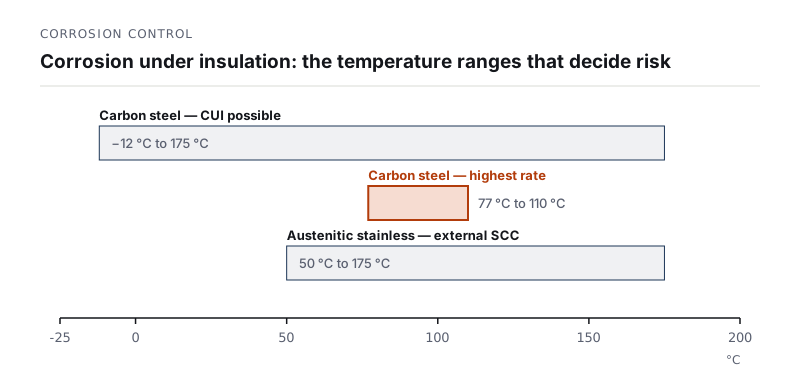
The range that matters is the range where liquid water can sit against the steel. Below freezing there is effectively no liquid water; well above the boiling point at the surface, the metal stays dry. Between the two, corrosion proceeds.
The most damaging condition is not a steady temperature at the middle of that range — it is cycling across it. A line that runs hot, stops, cools, and restarts, spends part of every cycle in the wet zone. Equipment operating continuously above the range often shows little CUI until the day it is shut down.
Limits of use
Published temperature ranges for CUI vary between references and depend on material, insulation type and service. This article describes the mechanism, not a threshold you can specify against. For a range you can put in a document, work from NACE SP0198 and the conditions of your own installation.
Stainless steel fails differently
On austenitic stainless steel, the concern under insulation is not general wall loss but external stress corrosion cracking. Chlorides — from the insulation itself, from seawater, from a wash-down — concentrate as water evaporates, and attack a surface under tensile stress.
The consequence is different in kind. Carbon steel thins, and thinning can be measured and trended. Stainless cracks, and a crack is not something you catch by monitoring thickness. Where the insulated equipment is stainless and the environment carries chlorides, chloride content of the insulation becomes a specification item.
What actually stops it
The barrier that matters is the coating on the steel, under the insulation. Cladding sheds bulk water and will be damaged in service; the vapour barrier limits ingress and will be breached at some point. Only the coating is in contact with the metal.
Selection follows service temperature and cycling more than anything else. Thermal spray aluminium is the reference for high-temperature service and for equipment where the consequence of failure is severe. Below its range, high-performance epoxy systems are the common choice. Both depend on surface preparation being right first — a coating applied over an inadequately prepared surface fails under insulation faster than it would in the open, because it never dries out. Insulated line work is one of the exposure zones that changes the coating specification itself, and it is not specified like the same steel left open to the weather.
The rest is design and discipline: draining rather than trapping, sealing penetrations properly, reinstating the vapour barrier after every intervention, and specifying low-chloride insulation on stainless.
Why it is usually found late
Nothing about CUI is visible until the insulation comes off. There is no rust bleed to notice, no change in appearance, no smell. The equipment looks exactly as it did the day it was installed.
That is the real problem to manage. Not the corrosion rate, which is ordinary — but the fact that a plant can run for years accumulating wall loss it has no reason to suspect, on assets it inspects least because they look intact.
Frequently asked questions
At what temperature does CUI occur?
Does removing the insulation solve the problem?
Can you inspect for CUI without stripping the insulation?
Which coating stops CUI?
Sources and references
- StandardNACE SP0198-2017 — Control of Corrosion Under Thermal Insulation and Fireproofing MaterialsAMPP · accessed August 1, 2026
Request a technical review
Describe your equipment and the problem. You get an engineering answer, not a sales pitch.