corrosion
Galvanic corrosion: when two metals share an electrolyte
Why the small part usually fails first, how the area ratio decides the severity, and why coating the wrong component makes the problem worse.
Galvanic corrosion needs three things at once: two different metals, electrical contact, and an electrolyte bridging both. Remove any one and it stops. The area ratio decides how bad it gets — a small anode on a large cathode fails fast, which is why a carbon steel bolt in a stainless flange is the wrong way round.
Galvanic corrosion is the most predictable corrosion mechanism there is, and one of the most common in industrial assemblies. It needs three conditions present simultaneously, all of them visible on a drawing long before anything corrodes.
Two different metals. An electrical connection between them. An electrolyte in contact with both.
Remove any one of the three and the mechanism stops. That is the whole of the prevention strategy, and it is why galvanic failures are almost always design decisions rather than material failures.
The area ratio decides the severity
This is the part that turns a minor concern into a fast failure, and it is regularly missed.
The corrosion current flowing between the two metals is spread over the anode surface. A large anode connected to a small cathode spreads that current thinly, and the loss is slow and diffuse. A small anode connected to a large cathode concentrates the same current onto very little metal, and the loss is fast and local.
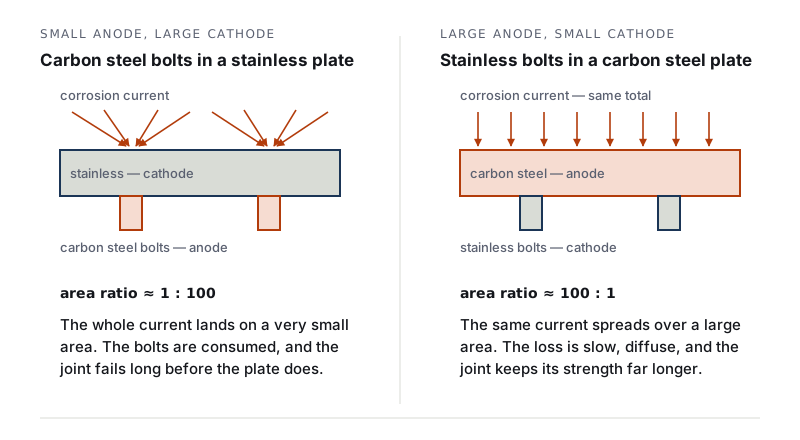
In practice this means the direction of a mixed-metal connection matters as much as the metals themselves.
| Assembly | Anode | Area ratio | Consequence |
|---|---|---|---|
| Carbon steel bolts in a stainless plate | The bolts | Small anode, large cathode | Rapid loss concentrated on the fasteners |
| Stainless bolts in a carbon steel plate | The plate | Large anode, small cathode | Slow, diffuse loss around the fasteners |
The rule that follows is simple enough to apply at the drawing stage: make the fastener the more noble of the two. A small part should never be the anode.
Why coating the anode makes it worse
The instinct is to coat the metal that corrodes. It is exactly backwards.
Coat the anode and you have not removed the driving force — you have only reduced the anode area. Every holiday, scratch and edge in that coating becomes a small exposed anode facing an undiminished cathode. The area ratio, which was survivable, becomes severe. The attack that would have spread across the whole surface now concentrates in a few pinholes, and perforates.
Coating the cathode reduces the area available for the cathodic reaction and lowers the driving current. Coating both is the reliable choice, and is what most specifications should say. Which system goes on is then the ordinary exposure question, answered by corrosivity category before product family.
Safety
On pressure-retaining or load-bearing assemblies, concentrated galvanic attack at a fastener or a weld can produce a local loss far ahead of any general corrosion rate — and one that routine thickness surveys will not find, because they are not looking at that scale. Where a mixed-metal joint carries load, inspect the joint, not the average.
Breaking the connection is more reliable than choosing metals
In an existing installation you rarely get to change the materials. What you can usually change is whether the two metals are electrically connected, and whether an electrolyte bridges them.
- Isolate electrically. Insulating sleeves, washers and gaskets at bolted joints break the current path. They must isolate completely: one metallic contact anywhere restores the couple, and a partial isolation is no isolation at all.
- Interrupt the electrolyte. Drain rather than trap. A joint that dries between wettings behaves very differently from one holding a permanent film of water — the same reason time of wetness dominates corrosion generally.
- Accept and sacrifice. Sometimes the right answer is to let a defined, replaceable component be the anode, and plan its replacement. That is what a sacrificial anode is: a galvanic couple deliberately arranged so that the part that corrodes is the part you meant to lose.
Limits of use
The galvanic series depends on the electrolyte. A ranking established for seawater does not transfer unchanged to condensate, process fluid or soil, and some couples behave differently or reverse under specific conditions. Read the series for the environment you actually have, and where the consequence of getting it wrong is severe, verify rather than assume.
It is designed in, not maintained out
Almost every galvanic failure traces back to a decision that cost nothing at the time: a fastener specified from stock, a bracket added in the field, a repair using whatever plate was available.
Once installed, the options are limited to isolation, coating and inspection — all of them ongoing costs to compensate for a choice that could have been free. The place to catch it is the drawing review, and the question is short: do two different metals touch, and can water reach them both?
Frequently asked questions
Which metal corrodes in a galvanic couple?
Does painting the assembly solve it?
How far apart do the metals need to be?
Is stainless steel always the cathode?
Sources and references
- StandardASTM G82-98(2014) — Standard Guide for Development and Use of a Galvanic Series — édition liée ; G82-98(2021) est en vigueurASTM International · accessed August 8, 2026
Request a technical review
Describe your equipment and the problem. You get an engineering answer, not a sales pitch.