corrosion
Flash rust and the blast-to-coat window
Why a surface prepared to SP 10 can fail its own specification hours later, and how to specify a holding time that survives a schedule.
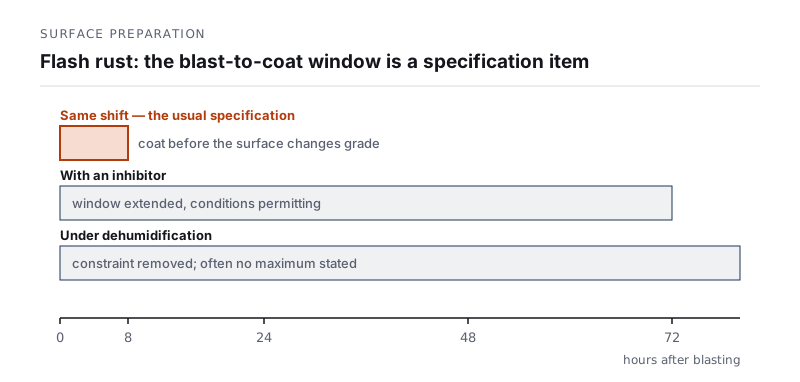
Flash rust is the thin oxide film forming on freshly blasted steel before the first coat. A surface accepted at SP 10 in the morning may no longer meet that grade by afternoon. The blast-to-coat window is a specification item, not a scheduling detail.
A steel surface blasted to SSPC-SP 10 is at its cleanest the second the nozzle stops. From that moment it starts moving in the wrong direction, and the only question is how fast.
Flash rust — sometimes called rust bloom — is the light oxide film that appears on freshly prepared steel. It is not a defect in the blasting. It is what happens when a chemically clean, highly reactive surface meets air containing moisture.
Preparation is a moment, not a state
This is the part specifications routinely get wrong. A blast cleaning grade describes a surface at the moment of inspection. It is not a property the steel keeps.
An inspector signs off SP 10 at ten in the morning. The crew moves to another area. Coating begins at four in the afternoon. In between, the surface has been sitting in whatever the air is doing — and it may no longer meet the grade it was accepted at.
Nobody re-inspects, because it was already accepted. The coating goes on over a surface that would fail today’s inspection, and the failure surfaces two years later as blistering that everyone attributes to the product.
Note
The blast-to-coat window belongs in the specification with a number attached, alongside the ambient conditions that must hold during it. A grade without a holding time is only half a requirement.
What controls how fast it blooms
Three conditions dominate, and they interact.
The gap between surface temperature and dew point. This is the one that matters most and the one most often measured too rarely. Steel close to dew point condenses moisture — invisibly, before anything looks wet. A common rule in coating work is to keep the surface a defined margin above dew point; that margin is in the coating manufacturer’s data sheet, and it applies during the holding time as much as during application.
Relative humidity. Higher humidity means more moisture available, and a shorter window. The same preparation that holds overnight in dry winter air can bloom in an afternoon in a humid summer.
Residual soluble salts. Salts are hygroscopic: they pull moisture out of the air and hold it against the steel. A surface with chloride contamination flash rusts faster than a clean one under identical conditions — which makes rapid blooming a useful field signal that the surface may not be as clean as its visual grade suggests.
Why it damages the coating
The lost cleanliness matters more than it looks.
A flash-rusted surface has a layer of loose oxide between the steel and the coating. The coating adheres to that layer, not to the metal. Whatever adhesion figure the manufacturer publishes was measured on a properly prepared surface — it does not apply here.
The oxide also holds moisture, and moisture under a barrier coating is what produces osmotic blistering. The mechanism takes time, which is precisely why the connection to a preparation shortcut taken years earlier is so rarely made.
Specifying a window that survives a schedule
A holding time only works if it is realistic. A specification demanding coating within two hours of blasting, on a project where the blasting crew and the coating crew are different contractors working different shifts, will be breached and then quietly ignored — which is worse than a longer window that is actually respected. The window is tied to the grade the job specified in the first place: near-white blast cleaning defines the state the window exists to preserve.
Three things make it workable:
- Size the blasting to the coating capacity, not to the blasting capacity. Preparing more surface per day than can be coated that day guarantees breaches.
- Define what happens on breach, before it happens: light sweep blast, re-inspection, and who pays. Left undefined, it is settled under schedule pressure, and cleanliness loses.
- Record surface temperature, dew point and humidity during the window, not only at the moment of application. Those readings are what tell you, later, whether a failure came from the product or from the conditions it was applied in.
Limits of use
Acceptable holding times and permitted degrees of flash rust vary by coating system, and are set by the manufacturer for the product actually specified. This article explains the mechanism and what to control. The numbers come from the data sheet for your system, not from a general rule.
The cheapest correction on the whole job
Re-blasting a flash-rusted surface is a light sweep, not a full re-preparation. Measured against a coating system that fails early and has to be removed and reapplied on live plant, it is close to free.
It rarely happens, because at the moment the decision is taken the surface looks acceptable, the schedule is tight, and the consequence is years away and will belong to someone else. That is a planning problem more than a technical one — and it is solved at specification, not on the day.
Frequently asked questions
Is a light flash rust acceptable before coating?
Can you just re-blast the flash-rusted area?
Does flash rust affect the surface profile?
Why does it happen faster in some conditions?
Sources and references
- StandardISO 8501-1:2007 — Preparation of steel substrates — Visual assessment of surface cleanliness — Part 1ISO · accessed August 8, 2026
- StandardSSPC-SP 10 / NACE No. 2-2024 — Near-White Metal Blast CleaningAMPP · accessed August 8, 2026
Request a technical review
Describe your equipment and the problem. You get an engineering answer, not a sales pitch.