wear protection
Selecting wear protection by mechanism, not by catalogue
Ceramic, polyurethane, hardfacing and elastomers each win somewhere and lose somewhere else. Which one is right follows from what is removing the material.
Every family of wear protection is optimised for one mechanism and compromised for another. Ceramic resists sliding abrasion and shatters under heavy impact. Elastomers absorb impact and cut easily. The selection follows from the mechanism, and the mechanism is read off the worn part — not off a hardness figure.
Ask a supplier which wear protection lasts longest and you will get an answer. Ask which mechanism their number was measured against, and the conversation becomes useful.
Every family of solution is optimised for something and compromised for something else. Selecting well means knowing what you are trading away, not finding the option with the best headline figure.
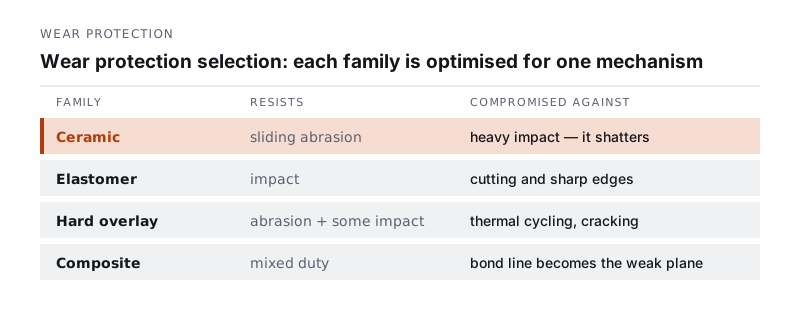
What each family sacrifices
Ceramic tiles and linings. Very high hardness, excellent against fine sliding abrasion, and brittle. Under heavy impact they crack and spall, and once a tile is gone the substrate is exposed and wears fast. They are also unforgiving in handling and installation, which matters where access is difficult.
Polyurethane and elastomers. They absorb impact energy by deforming, and recover. Excellent where lumps land, poor where sharp particles slide under load — the surface is cut rather than deflected. Service temperature is a real limit, and one that is regularly discovered after installation.
Hardfacing and weld overlays. Applied where they are needed, repairable in place, and available in a wide range of hardnesses. The heat input can distort thin sections, and the result depends heavily on the welder. Best where a component is worth rebuilding repeatedly.
Epoxy wear compounds. Applied cold, which is decisive where welding is not permitted or not practical. They rebuild geometry as well as protect, and they cure — which consumes window time that a bolt-on solution does not. Their limits are temperature and heavy impact.
Chromium carbide and composite plate. Strong against sliding abrasion, formable within limits, and cuttable only with the right equipment. The joints between plates are where the wear starts.
The selection follows the mechanism
The sequence that produces defensible choices is short, and the first step is the one usually skipped.
Read the worn part. Directional grooves following the flow indicate sliding abrasion — hardness is the lever. Localised deformation, pitting or cracked edges indicate impact — toughness is the lever. Roughened, irregular loss where turbulence is highest indicates erosion-corrosion, and chemistry has to be answered too. Reading the mechanism before choosing a material covers how these signatures separate in slurry service.
Check whether the wear is distributed or concentrated. This matters more than the material comparison.
Establish whether chemistry is involved. It changes the shortlist entirely, and a corrosion-resistant alloy can underperform plain steel where abrasion keeps removing its passive film.
Then compare materials — against the mechanism you have identified, not against a general wear resistance claim.
Note
Where wear is concentrated in a narrow band rather than spread across a surface, the problem is geometry, not material. Redirecting the stream, changing the impact angle or fitting a sacrificial pocket will outperform any upgrade — and usually costs less. A harder liner in that position buys time and leaves the cause untouched.
Mixing solutions is usually right
Wear is rarely uniform, and fitting one material throughout means over-specifying most of the surface to protect the part that fails first.
A transfer chute takes impact at the landing zone and sliding abrasion down the trough. Elastomer where the stream lands and ceramic further down outlasts either used alone, and costs less than ceramic everywhere.
The objection is practical rather than technical: two materials mean two spares, two installation methods and two suppliers. Where that overhead is real, a single compromise material may still win — but it should be chosen knowingly, not by default.
What laboratory numbers do and do not tell you
Standard tests exist because comparing materials needs a common basis. ASTM G65 ranks dry sand abrasion resistance; ASTM G76 covers solid particle erosion by gas jet.
They are useful for shortlisting. They are not life predictions, and a clean ranking under one mechanism says nothing about behaviour under another. They also say nothing about your particle size, solids concentration, velocity, temperature or pH — and those interact.
Limits of use
Wear rates do not transfer between installations. Use published comparisons to shortlist, and your own position-by-position history to decide. Where no history exists, the cheapest way to build one is to fit two candidates in the same position on successive changes, and measure.
The variable nobody wants to hear about
Wear rate rises steeply with velocity — considerably faster than proportionally where impact is involved. It is often the most influential operating variable and the least available for adjustment, because throughput sets it.
That does not make it irrelevant. It means a plant that raises throughput and keeps its liner change schedule has already planned for a failure it caused. The interval was calibrated at the old rate.
Frequently asked questions
Which wear protection lasts longest?
Is ceramic always better than steel?
Can you mix solutions in the same equipment?
How much does a laboratory ranking tell you?
Sources and references
- StandardASTM G65-16(2021) — Standard Test Method for Measuring Abrasion Using the Dry Sand/Rubber Wheel ApparatusASTM International · accessed August 8, 2026
- StandardASTM G76-18 — Standard Test Method for Conducting Erosion Tests by Solid Particle Impingement Using Gas JetsASTM International · accessed August 8, 2026
All articles in wear protection
Request a technical review
Describe your equipment and the problem. You get an engineering answer, not a sales pitch.