wear protection
Repair in place or replace
The comparison is rarely about cost. Access, cure time and the maintenance interval decide it — and they favour different answers than a price sheet does.
Comparing the price of a repair to the price of a replacement answers the wrong question. What decides is how much of the access window each consumes, and whether the result reliably clears the next one. A repair that is cheaper and occupies more critical path is the more expensive option.
The usual comparison sets the cost of a repair against the cost of a new component, and picks the lower number. It is the wrong comparison, and it produces decisions that look right on a spreadsheet and cost more in practice.
Three constraints decide, and none of them is a price.
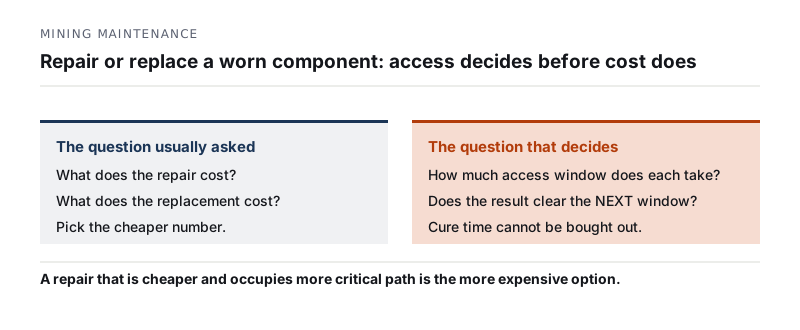
Access decides before cost does
In a plant that opens during planned shutdowns, the scarce resource is not money — it is hours on the critical path.
A repair carried out in place, requiring preparation, application and cure, occupies that path for its full duration. A replacement component that bolts on may cost several times more in materials and release the equipment in a fraction of the time.
Where the window is tight and the queue behind it is long, the more expensive part is frequently the cheaper decision. Where access is easy and the window generous, the arithmetic reverses.
The question is not what each option costs. It is what each option consumes of the resource you are short of.
Cure time is the constraint that cannot be bought out
Application time scales with crew size. Cure does not.
Two crews halve the application; neither affects the cure. And cure depends on ambient and substrate temperature, which in a stopped plant is usually lower than in operation — the equipment has cooled, heating is off, and the cure runs slower than the data sheet’s reference conditions.
The pressure that follows is predictable. The window is closing, the repair is not fully cured, and returning to service early looks like a small compromise. It is not: a system put into duty before cure completes never develops the properties it was selected for, and the failure arrives months later without an obvious cause.
Safety
Where a repair restores pressure-retaining or load-bearing capability, cure and inspection are not schedule variables. Returning such equipment to service on an incomplete cure converts a schedule problem into an integrity problem.
Expected life is measured in maintenance intervals
A repair lasting eleven months in an annual cycle fails while the plant is running. A repair lasting thirteen clears the window. The second is worth far more than the first, even at twice the price.
And life beyond the next window is worth nothing unless it reliably reaches the one after. Paying for eighteen months in an annual cycle buys nothing that thirteen months did not already buy.
The margin matters as much as the average. A method lasting fourteen months on average but ranging from nine to nineteen is worse than one lasting thirteen predictably, because the plan is built against the low end.
Where cold repair genuinely wins
Not because it is cheaper — because it removes constraints that welding imposes.
- No hot work permit, which matters in flammable service or where isolation is difficult.
- No heat distortion, which matters on thin sections and machined surfaces.
- Geometry rebuilt as well as protected, on profiles where weld deposit would need machining back.
- No qualified welder required on site, which matters at remote installations.
Its limits are equally clear: service temperature, heavy impact, and the fact that it cures — consuming window time a mechanical fix does not.
Surface preparation decides whether any of it holds
This is the part that gets compressed when the schedule tightens, and it is the variable that determines the outcome.
A repair compound applied over an inadequately prepared surface fails at the bond line, regardless of the strength printed on the container. The published adhesion figure was measured on a properly prepared substrate; it does not transfer to yours.
On equipment that has been in service, preparation takes longer than expected — contamination is embedded, the surface is irregular, and the grade specified for new steel is harder to reach. That time belongs in the plan, not in the contingency. Which grade the job actually requires depends on the substrate, its condition and the system going over it — the surface preparation selector resolves it case by case.
Limits of use
Product performance figures come from the manufacturer’s data sheet, measured under their conditions. This article describes what governs the decision, not which product to use. Take temperature limits, cure schedules and adhesion values from the data sheet for the product actually specified.
The decision worth documenting
Whatever is chosen, record what was done, in which position, and how long it lasted.
That measurement is the single most useful input to the next decision in the same location — and it is the one most often unavailable, because the repair was completed under pressure and nobody wrote it down. Two data points from the same position beat any general comparison.
Frequently asked questions
Is an in-place repair always cheaper?
When is cold repair preferable to welding?
How do you know a repair will hold?
Can a repaired component be repaired again?
Sources and references
- StandardASTM D4541-22 — Standard Test Method for Pull-Off Strength of Coatings Using Portable Adhesion TestersASTM International · accessed August 8, 2026
All articles in wear protection
Request a technical review
Describe your equipment and the problem. You get an engineering answer, not a sales pitch.