wear protection
Cavitation damage on pumps and valves
How to tell cavitation from abrasion, why a harder impeller delays the failure without fixing it, and what actually stops the damage.
Cavitation is vapour bubbles forming in low-pressure zones and collapsing against a surface. The damage looks like nothing else — deep, spongy, localised pitting rather than directional wear. A harder material buys time; only changing the hydraulic conditions stops it.
Cavitation is the one wear mechanism that is unmistakable once you have seen it, and the one most often treated as a material problem.
Vapour bubbles form where the local pressure drops below the vapour pressure of the liquid. They travel with the flow into a higher-pressure region and collapse — violently, and against whatever surface they happen to be touching. Each collapse is small. There are a great many of them.
The damage looks like nothing else
This is what makes field diagnosis straightforward, and what makes the frequent confusion with abrasion avoidable.
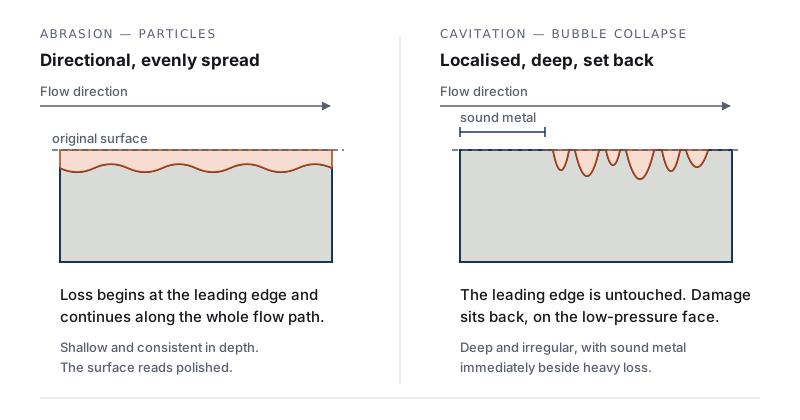
Abrasion produces directional grooves that follow the flow, and a polished, worn appearance. The loss is broadly distributed along the flow path.
Cavitation produces deep, irregular pits with a spongy or honeycombed texture. The loss is sharply localised, with sound metal immediately alongside heavily damaged metal. On an impeller it typically sits on the low-pressure face of the vane, at some distance behind the leading edge — not at the point of first contact with the fluid.
That location is diagnostic in itself. Damage at the leading edge suggests particles. Damage behind it, on the suction side, suggests bubbles.
Note
Photograph the damage before the component is refurbished, with the orientation noted. The position of the pitting on the vane says more about the hydraulic condition than any measurement taken afterwards, and it is lost the moment the part is rebuilt.
It is a hydraulic condition, not a material weakness
The pump is not cavitating because the impeller is too soft. It is cavitating because the pressure at the impeller inlet falls too low for the duty.
The causes are all upstream of the material:
- Suction lift too high, or the source level lower than the design assumed.
- Suction line restricted — undersized, too many fittings, a partly blocked strainer, a valve not fully open.
- Fluid temperature raised, which raises vapour pressure and reduces the margin.
- Operating far from the best efficiency point, particularly at low flow, where recirculation creates local low-pressure zones regardless of the overall suction condition.
Each of these reduces the available margin or increases what the pump requires. Fitting a harder impeller changes none of them.
Why the material answer is still worth something
Because time matters. A more resistant material extends the interval before the component has to come out, which can align the replacement with a planned window rather than an unplanned stop.
That is a legitimate reason to upgrade — as an interim measure while the hydraulic cause is investigated, or as a permanent accommodation where the cause genuinely cannot be corrected. It becomes a mistake only when it is treated as the solution and the investigation never happens. If the upgrade route is taken, the material still follows the mechanism rather than a general hardness ranking.
The cost is paid before the failure
Cavitation degrades hydraulic efficiency continuously as it progresses. The vane profile changes, the flow separates earlier, and the pump consumes more energy for the same duty.
That cost accumulates quietly and frequently exceeds the price of the wear part several times over. It is also invisible unless someone is trending pump performance — which is why the damage is usually discovered at the point where noise and vibration have become impossible to ignore, long after the energy penalty began.
Limits of use
This article covers recognition and cause. Determining the actual margin at your impeller inlet, and whether it is sufficient, is a hydraulic calculation specific to your installation — fluid, temperature, suction geometry and duty point. It belongs to the pump manufacturer’s data and a competent hydraulic assessment, not to a general rule.
What to check before ordering anything
Confirm the damage is cavitation, from the texture and its position on the vane. Then look upstream before looking at materials: strainer condition, valve positions, suction line integrity, fluid temperature against design, and where the pump is actually operating on its curve relative to best efficiency.
Most of those cost nothing to check, and one of them is usually the answer.
Frequently asked questions
How do you tell cavitation from abrasion?
Will a harder impeller stop cavitation?
What causes it in practice?
Can a coating repair a cavitated surface?
Sources and references
- StandardASTM G32-16(2021) — Standard Test Method for Cavitation Erosion Using Vibratory ApparatusASTM International · accessed August 8, 2026
- StandardASTM G134 — Standard Test Method for Erosion of Solid Materials by a Cavitating Liquid JetASTM International · accessed August 8, 2026
All articles in wear protection
Request a technical review
Describe your equipment and the problem. You get an engineering answer, not a sales pitch.