mining
Wear mechanisms in slurry service
Sliding abrasion, impact and erosion-corrosion call for different answers. Identifying which one dominates is what makes a material choice defensible.
Three mechanisms damage equipment in slurry service, and they call for opposite properties. Sliding abrasion favours hardness, impact favours toughness, erosion-corrosion favours chemical stability. Selecting for the wrong one produces a material that fails faster than what it replaced.
Two chutes in the same plant, handling the same ore, wear out at very different rates. The usual response is to specify a harder material for the one that fails first — and it fails faster still.
That outcome is not bad luck. It is what happens when a material is selected against the wrong mechanism.
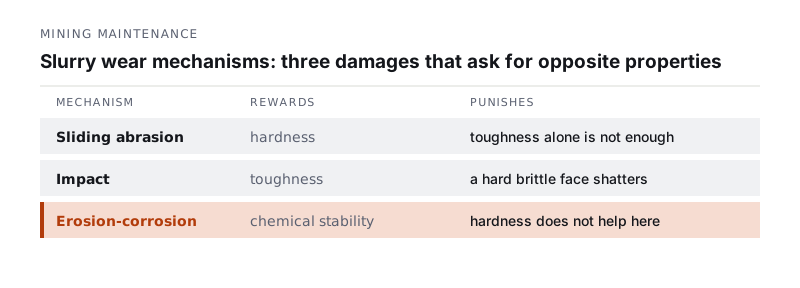
Three mechanisms, three opposite answers
What removes material in slurry service is rarely one thing, but one thing usually dominates at any given position.
Sliding abrasion — particles dragged along a surface under moderate pressure, cutting and ploughing as they pass. This is the mechanism in a pipe wall, along a chute floor, across a mill liner between lifters. Resistance comes from hardness: a surface harder than the particles is not easily cut.
Impact — particles striking a surface at an angle, delivering energy in a small area. This is what happens at a transfer point, on the leading edge of a lifter, where a stream lands after a drop. Resistance comes from toughness: the ability to absorb energy and deform rather than crack. Hard materials do poorly here, because hardness usually comes at the cost of brittleness.
Erosion-corrosion — mechanical removal and chemical attack acting together, each accelerating the other. Resistance comes from chemical stability under mechanical disturbance, which is a different property again.
The difficulty is that these call for opposite characteristics. A material optimised for one is generally worse at another. There is no material that leads on all three, and any supplier claiming otherwise is describing a test, not a service.
Why erosion-corrosion is worse than the sum of its parts
Take a stainless steel component in an acidic slurry. Its corrosion resistance comes from a passive oxide film a few nanometres thick, which reforms continuously as it is attacked.
Now add abrasive particles. They remove that film mechanically, faster than it can reform. The metal underneath is exposed bare to the electrolyte, corrodes, and the corrosion product — softer than the parent metal — is swept away by the next particles. The cycle repeats.
Neither mechanism alone would produce that rate. The particles would polish a passive surface slowly; the acid would be held off by the film. Together they remove material at a rate that surprises people who assessed each separately.
Note
This is the practical reason a corrosion-resistant alloy can underperform a plain carbon steel liner in a slurry circuit. The alloy’s advantage depends on a film that the service does not allow to exist.
Reading the surface
Worn components carry a record of what removed them. It is the cheapest diagnostic available, and it is usually thrown in a skip.
- Directional grooves and a polished finish, following the flow — sliding abrasion dominates. Hardness is the lever.
- Localised deformation, pitting, chipped or cracked edges — impact dominates. Toughness is the lever, and the flow path is worth examining before the material is.
- Undercutting, roughened and irregular loss, often worse where turbulence is highest — erosion-corrosion. Both chemistry and mechanics need answering.
- Wear concentrated in one narrow band — the mechanism matters less than the geometry. Redirecting the stream will outperform any material change.
That last case is worth dwelling on. Where wear is concentrated rather than distributed, the problem is usually flow, not material. Changing the liner grade addresses the symptom; changing the impact angle or fitting a sacrificial wear pocket addresses the cause — and often costs less.
What laboratory numbers can and cannot tell you
Standard tests exist because comparing materials needs a common basis. ASTM G65 ranks resistance to dry sand abrasion; ASTM G75 characterises slurry abrasivity and material response.
They are genuinely useful for ranking candidates under controlled conditions. They are not life predictions. A test that produces a clean ranking under one mechanism tells you nothing about behaviour under another, and nothing about your particle size distribution, your solids concentration, your pH, your temperature or your velocity.
Limits of use
Wear rates cannot be transferred between installations. Particle hardness and shape, solids concentration, velocity, impact angle, pH and temperature all shift the outcome, and they interact. Use published comparisons to shortlist, and your own position-by-position history to decide.
Velocity is the variable nobody wants to hear about
Wear rate rises steeply with velocity — considerably faster than proportionally, particularly where impact is involved. It is often the single most influential operating variable, and the one least available for adjustment because it is set by throughput.
That does not make it irrelevant. It means that when throughput is increased, wear does not increase in the same proportion, and a maintenance interval calibrated at the old rate will no longer hold. A plant that raises throughput and keeps its liner change schedule is planning for a failure it has already caused.
Start with the mechanism, not the catalogue
The sequence that produces defensible decisions is short:
Look at the worn part and identify what removed it. Check whether the wear is distributed or concentrated — if concentrated, look at flow before material. Establish whether chemistry is involved, because that changes the answer entirely.
That is where this article stops. Once the mechanism is established, the material question is a separate exercise with its own trade-offs, and it is worked through in selecting wear protection by mechanism — ceramic, polyurethane, hardfacing and elastomers each answer one mechanism well and another badly.
Most disappointing material upgrades skip the first step.
Frequently asked questions
Is a harder material always better against wear?
What does an ASTM G65 result actually tell you?
How do you tell impact wear from abrasion in the field?
Why does wear accelerate near the end of a liner's life?
Sources and references
- StandardASTM G65-16(2021) — Standard Test Method for Measuring Abrasion Using the Dry Sand/Rubber Wheel ApparatusASTM International · accessed August 8, 2026
- StandardASTM G75-15(2021) — Standard Test Method for Slurry Abrasivity (Miller Number) — édition liée ; G75-24 est en vigueurASTM International · accessed August 8, 2026
Request a technical review
Describe your equipment and the problem. You get an engineering answer, not a sales pitch.