standards
NACE MR0175 vs MR0103: What's the Difference?
Understand the critical differences between NACE MR0175 (ISO 15156) and NACE MR0103 for specifying materials in sour gas (H2S) environments.
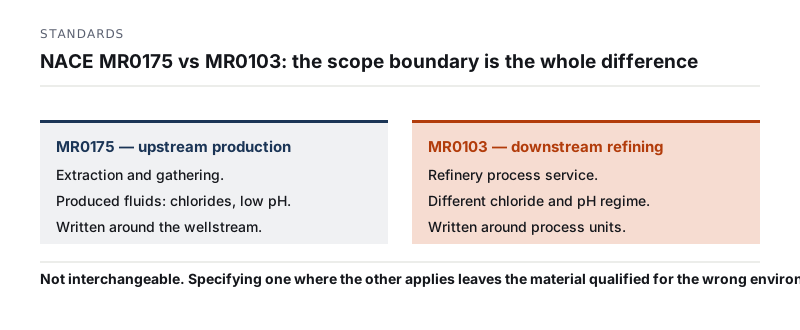
NACE MR0175 applies strictly to upstream oil and gas production (extraction), while NACE MR0103 applies to downstream refining operations. You cannot simply substitute one for the other, as the environmental conditions (chlorides, pH, temperature) vary drastically between the two sectors.
Hydrogen sulfide (H₂S) is a deadly and highly corrosive gas found throughout the oil, gas, and mining industries. When carbon steel or certain alloys are exposed to aqueous H₂S, they can suffer from catastrophic Sulfide Stress Cracking (SSC).
To prevent explosions and pipeline ruptures, engineers rely on two critical standards: NACE MR0175 and NACE MR0103. While both deal with H₂S cracking, they are designed for entirely different parts of the industry. Specifying the wrong one can lead to immediate compliance failures.
Upstream vs. Downstream: The Core Difference
The primary difference between the two standards is their scope of application.
NACE MR0175 (ISO 15156) - Upstream
This standard is dedicated to upstream oil and gas production. This includes wellheads, flowlines, gathering lines, and initial processing facilities.
- The Environment: Upstream environments are incredibly hostile. They don’t just contain H₂S; they contain highly saline formation water (chlorides) at high temperatures and high pressures.
- The Risk: Because of the chlorides, MR0175 must account for both Sulfide Stress Cracking (SSC) and Chloride Stress Corrosion Cracking (SCC).
NACE MR0103 - Downstream
This standard is dedicated to downstream petroleum refining.
- The Environment: Refineries process crude oil that has already been desalted. Therefore, the chloride content in downstream operations is generally very low. However, refineries use various catalysts and operate at specific pH levels that create different cracking risks.
- The Risk: MR0103 focuses almost exclusively on Sulfide Stress Cracking (SSC) in wet H₂S environments, without the compounding factor of high chlorides.
Comparison Table
| Feature | NACE MR0175 (ISO 15156) | NACE MR0103 |
|---|---|---|
| Industry Sector | Upstream (Production, Extraction) | Downstream (Refining) |
| Primary Corrosive Agent | H₂S + Chlorides (Brine) | H₂S (Wet sour gas) |
| Cracking Mechanisms Addressed | SSC, SCC, Galvanic cracking | Primarily SSC |
| Environmental Severity Defined By | H₂S partial pressure, pH, Chlorides, Temp | Total H₂S content, pH, presence of cyanides |
| International Equivalent | ISO 15156 | None directly (ANSI/NACE MR0103) |
Material Hardness Requirements
Both standards control cracking by strictly limiting the hardness of the base metal, the weld, and the heat-affected zone (HAZ). Harder materials are significantly more susceptible to hydrogen embrittlement and SSC.
For standard carbon steel, both MR0175 and MR0103 generally limit maximum hardness to 22 HRC (Rockwell C) or 237 HBW (Brinell). However, the specific heat treatment requirements and testing protocols differ, which is why a certificate of compliance must explicitly state which standard the material was tested against.
Practical Specification Advice
If you are specifying valves, piping, or instruments:
- Never assume interchangeability. A valve rated for MR0103 is not automatically safe for an MR0175 upstream wellhead due to the lack of chloride resistance verification.
- Look for dual certification. Many premium manufacturers test and certify their 316 SS and Duplex components to meet both standards.
- Check the revisions. NACE standards are updated regularly. Always specify the latest revision (e.g., NACE MR0175-2021) in your procurement documents.
Whichever standard applies, the certification travels in the supplier documentation rather than in the sales sheet, and what a data sheet actually commits to is the same discipline applied to a different document.
Frequently asked questions
What does NACE MR0175 stand for?
Can a material be certified to both MR0175 and MR0103?
Is NACE MR0175 the same as ISO 15156?
Sources and references
- StandardISO 15156-1:2020 — Materials for use in H2S-containing environments — Part 1ISO · accessed August 8, 2026
- StandardNACE MR0103 / ISO 17945:2015 — Metallic materials resistant to sulfide stress cracking in corrosive petroleum refining environmentsAMPP · accessed August 8, 2026
Request a technical review
Describe your equipment and the problem. You get an engineering answer, not a sales pitch.