standards
Reading an Industrial Coating TDS Like a Pro
Stop getting fooled by marketing claims. Learn the 8 critical points to check on any industrial coating Technical Data Sheet (TDS) before you specify it.
A Technical Data Sheet (TDS) is a legal document, not a marketing brochure. Always check Volume Solids for true cost calculation, Pot Life for application limits, and the exact testing standards (ASTM/ISO) used for performance claims.
When specifying a protective coating, the marketing brochure tells you what the manufacturer wants you to hear. The Technical Data Sheet (TDS) tells you what the product can actually do.
However, a TDS can be overwhelming, filled with test methods and chemical jargon. This guide breaks down the 8 critical points you must check on any industrial coating TDS to avoid costly failures.
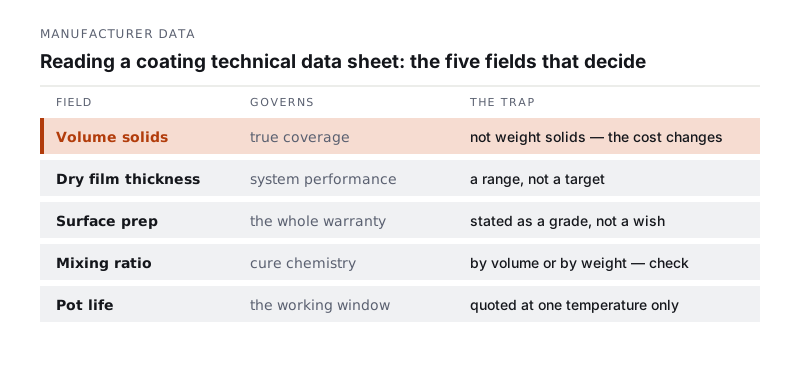
1. Volume Solids (Not Weight Solids)
This is the most important metric for cost calculation. Volume solids tell you how much of the paint stays on the wall after the solvents evaporate.
- Low Solids (40-60%): High solvent content. You need to apply a lot of wet paint to get the required dry film.
- High Solids (70-95%): Environmentally friendlier, requires less wet paint to achieve thickness.
- 100% Solids: No evaporation. If you apply 20 mils wet, you get 20 mils dry.
Warning: Never compare the price per gallon of two paints without comparing their volume solids. Check out our Coating Coverage Calculator to see why.
2. Recommended Dry Film Thickness (DFT)
The manufacturer will specify a recommended DFT range per coat (e.g., 4.0 to 6.0 mils).
- If you apply less than the minimum, you risk pinpoint rusting and premature failure.
- If you apply more than the maximum, you risk solvent entrapment, cracking, or severe sagging.
3. Surface Preparation Requirements
The best coating in the world will fail if applied to a poorly prepared surface. The TDS will state the exact SSPC or ISO surface preparation degree required (e.g., SSPC-SP10 Near-White Metal). It will also state the required surface profile depth (e.g., 2.0 to 3.0 mils).
4. Mixing Ratio
For plural-component coatings (epoxies, polyurethanes), the mixing ratio is critical. A ratio of 4:1 means 4 parts Part A (Resin) to 1 part Part B (Hardener). Mixing “by eye” instead of measuring precisely will result in a coating that never cures.
5. Pot Life and Induction Time
- Induction Time (Sweat-in time): The time you must wait after mixing Part A and B before you can start spraying.
- Pot Life: The absolute maximum time you have to apply the mixed paint before it cures in the bucket. Note that pot life decreases drastically in hot weather.
6. Overcoating Window (Recoat Time)
When applying multiple coats, you must adhere to the overcoating window.
- Minimum Recoat Time: If you apply the second coat too soon, the solvents from the first coat will get trapped.
- Maximum Recoat Time: If you wait too long, the first coat becomes too hard, and the second coat won’t stick. (If you exceed this, you usually have to sand or sweep-blast the surface).
7. Curing Schedule
A coating might feel “dry to touch” in 4 hours, but that doesn’t mean you can put the asset back into service. Look for the “Cure for Service” or “Cure for Immersion” times. For a chemical tank, this might be 7 to 10 days at 25°C. Putting it in service earlier will destroy the coating.
8. Performance Testing Standards
Don’t just read “Excellent Abrasion Resistance.” Look for the specific ASTM or ISO test method used.
- Adhesion: ASTM D4541
- Salt Fog / Corrosion: ASTM B117
- Abrasion: ASTM D4060 (Taber Abraser)
If a TDS lacks specific test methods, be extremely skeptical of the performance claims.
Frequently asked questions
What is Volume Solids in a coating TDS?
Is Pot Life the same as Shelf Life?
Why is the theoretical spread rate always higher than the actual coverage?
Sources and references
- StandardASTM D5201 - Standard Practice for Calculating Formulation Physical Constants of Paints and CoatingsASTM International · accessed August 8, 2026
- StandardSSPC-PA 2-2022 — Procedure for Determining Conformance to Dry Coating Thickness RequirementsAMPP · accessed August 8, 2026
Request a technical review
Describe your equipment and the problem. You get an engineering answer, not a sales pitch.