standards
ASTM D4541 Pull-Off Adhesion Testing
Learn how to conduct and interpret ASTM D4541 pull-off adhesion tests. Understand the difference between cohesive and adhesive failures in industrial coatings.
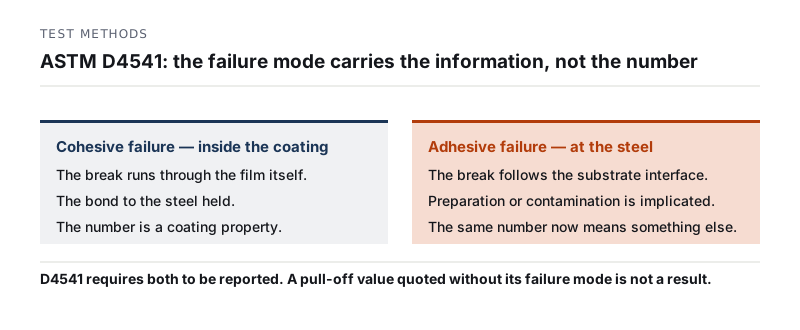
A high pull-off value doesn't mean much if the failure mode is adhesive (between the coating and the steel). ASTM D4541 requires reporting both the pull-off strength (e.g., 1500 psi) and the exact nature of the failure (e.g., 100% cohesive within the primer) to be valid.
Applying a high-performance coating over poorly prepared steel is like building a house on sand. The only definitive way to prove that a coating has properly bonded to a substrate in the field is through destructive testing.
The global standard for this is ASTM D4541: Standard Test Method for Pull-Off Strength of Coatings Using Portable Adhesion Testers (often referred to interchangeably with its European counterpart, ISO 4624).
This guide explains how the test works and, more importantly, how to interpret the results correctly.
How the ASTM D4541 Test Works
The procedure is straightforward but requires meticulous preparation:
- Surface Prep: The coated surface is lightly abraded and cleaned.
- Gluing: A metal loading fixture (commonly called a “dolly” or “pull stub”) is glued to the coating using a high-strength epoxy adhesive.
- Curing: The adhesive is allowed to cure fully (often 24 hours).
- Scoring: If required (usually for thick or elastomeric coatings), the coating is cut (scored) down to the substrate around the perimeter of the dolly.
- Pulling: A portable hydraulic or pneumatic tester is attached to the dolly. It applies a perpendicular pulling force at a controlled rate until the dolly is completely detached from the surface.
Interpreting the Results: Numbers vs. Nature
A common mistake made by inexperienced inspectors is only looking at the gauge pressure (the psi or MPa value) when the dolly pops off.
ASTM D4541 requires reporting two distinct pieces of information:
- The Pull-Off Strength (the numerical value).
- The Nature of the Failure (where and how the system broke).
The figure the result is compared against comes from the product documentation, so what a data sheet does and does not commit to decides whether the comparison is a fair one.
Adhesive vs. Cohesive Failure
Understanding failure modes is critical. A coating system typically consists of the Substrate (A), the Primer (B), the Midcoat (C), and the Topcoat (D).
- Adhesive Failure: The break occurs between layers. For example, between the steel (A) and the primer (B). This is a failure of the bond.
- Cohesive Failure: The break occurs within a single layer. For example, the primer itself splits in half. This is a failure of the material’s internal strength, meaning the bond to the steel is actually stronger than the paint itself.
Reporting Format Example
According to ASTM D4541, a failure is reported using percentages of the dolly face.
Example Report:
Result: 1,200 psi Failure Mode: 70% Cohesive within coat B (primer) / 30% Adhesive between coats B and C.
If a specification demands a minimum of 1000 psi, and you pull 1200 psi with a 100% cohesive failure in the primer, the coating system has passed with flying colors. The bond to the steel was never even broken.
3 Tips for Accurate Testing
- Don’t rush the glue: Using a “5-minute” quick-set epoxy in cold weather is the leading cause of glue failures. Use a proper structural epoxy and allow 24 hours to cure.
- Control the pull rate: The tester must increase pressure smoothly and continuously (not exceeding 150 psi/sec). Jerking the hydraulic pump will cause a premature shock-fracture.
- Watch the temperature: Testing hot steel in the middle of summer will yield lower pull-off values than testing the same steel in the cool morning, as coatings become softer at high temperatures.
Frequently asked questions
What is a good pull-off adhesion value?
Do I have to score around the dolly before testing?
What if the glue fails before the paint?
Sources and references
- StandardASTM D4541-22 — Standard Test Method for Pull-Off Strength of Coatings Using Portable Adhesion TestersASTM International · accessed August 8, 2026
- StandardISO 4624:2023 — Paints and varnishes — Pull-off test for adhesionISO · accessed August 8, 2026
Request a technical review
Describe your equipment and the problem. You get an engineering answer, not a sales pitch.