mining
Repairs scoped to the shutdown window
Why the longest-lasting repair is often the wrong one, how cure time consumes a window, and what to decide before the plant stops rather than during.
Where a plant only opens during planned shutdowns, component life is worth nothing unless it exceeds the interval between windows. A repair lasting eleven months in an annual cycle fails at the worst moment. The objective is not maximum life — it is life that reliably clears the next window.
A repair that lasts eighteen months sounds better than one that lasts thirteen. In a plant with an annual shutdown, they are worth exactly the same — both carry the equipment to the next window and no further.
A repair lasting eleven months, however, is worth far less than the thirteen-month option, even if it costs half as much. It fails while the plant is running, and an unplanned stop costs a multiple of what was saved.
This is the arithmetic that should drive repair selection in a shutdown-governed plant, and it is not the arithmetic most comparisons use.
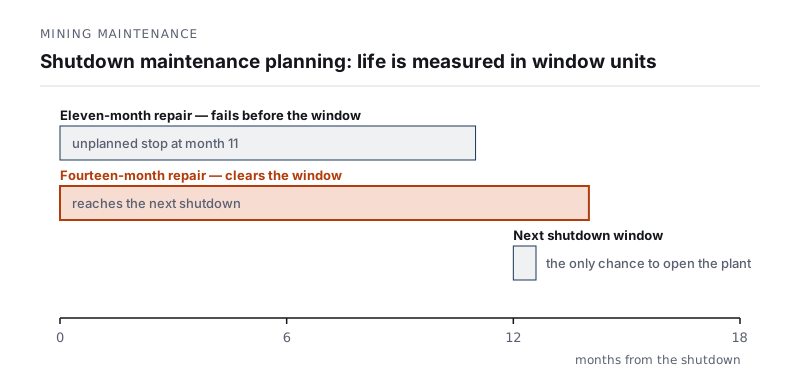
Component life only matters in window units
The relevant question is never “how long does this last?” It is “does this clear the next window, with margin?”
That reframing changes the shortlist. Options separated by months of nominal life may be equivalent in practice, while options separated by weeks may sit on opposite sides of a boundary. Two consequences follow:
- Paying for life beyond the next window is paying for nothing, unless it reliably reaches the window after.
- The margin matters as much as the mean. A repair that lasts fourteen months on average, but ranges from nine to nineteen, is worse than one that lasts thirteen predictably — because you plan against the low end, not the average.
Predictability outranks duration. A maintenance plan is built on when things will be done, not on how long they might last.
The window is shorter than the shutdown
The plant is down for a fixed number of days. The time genuinely available for a given repair is much less, and the difference catches people out.
Before any work starts: isolation and lockout, cooling to a workable temperature, cleaning, draining, access and scaffolding. After the work: inspection, reinstatement, removal of access, recommissioning. And on the critical path, all of this competes with every other job in the same area.
On a coating repair specifically, the application itself is often the smallest part. Surface preparation to the specified grade takes longer than expected on equipment that has been in service. And then there is cure.
Note
When comparing repair options, compare total window occupation — preparation, application, cure, inspection — not application time. A product that applies in two hours and cures in twenty-four occupies more window than one applying in six and curing in eight.
Cure time is a scheduling constraint, not a technical footnote
Cure time is where shutdown plans most often break, because it is the one element that cannot be accelerated by adding people.
Two crews halve application time. Neither affects cure. And cure depends on ambient and substrate temperature, which in a stopped plant is frequently lower than during operation — the equipment has cooled, the heating is off, and the cure runs slower than the data sheet’s reference conditions suggest.
The pressure that follows is predictable: the window is closing, the coating is not fully cured, and returning to service early looks like a small compromise. It is not. A system put into duty before cure completes never develops the properties it was selected for, and the failure arrives months later without an obvious cause. Cure is also what most often settles whether the part is repaired in place or replaced, because a replacement carries no cure at all.
Safety
Where a repair restores pressure-retaining or load-bearing capability, cure and inspection requirements are not schedule variables. Returning such equipment to service on an incomplete cure transfers a schedule problem into an integrity problem.
Decide the scope before the plant stops
Every shutdown accumulates work that was not in the original scope. Some of it genuinely emerged on opening. Much of it was known, and was added because the equipment happened to be accessible.
The distinction is worth defending. Work that could have been done online, added to a window, consumes critical-path hours that a genuinely window-dependent job may need. The rule that holds up under pressure: the scope contains what requires the plant to be stopped, and nothing else — with a defined and small allowance for what is found on opening.
That allowance should be sized deliberately. Sized at zero, the first surprise breaks the plan. Sized generously, it absorbs work that never needed the window.
What to fix before the next window
Three preparations pay for themselves, and all of them happen while the plant is running:
Know the condition before you open. Thickness surveys, wear measurements and inspection during operation turn discovery into planning. Opening equipment to find out what is wrong means deciding under time pressure, with whatever materials are on site.
Have the materials and the specification ready. Selecting a product during a shutdown means selecting from what is available, not from what is right.
Record what was done and how long it lasted. The single most useful input to the next scoping decision is the measured life of the last repair in that exact position — and it is the input most often unavailable, because nobody wrote it down.
Frequently asked questions
Is it worth paying more for a longer-lasting repair?
What consumes a shutdown window besides the work itself?
Can cure time be shortened safely?
Should everything be repaired during the shutdown?
Sources and references
- StandardSSPC-SP 10 / NACE No. 2-2024 — Near-White Metal Blast CleaningAMPP · accessed August 8, 2026
Request a technical review
Describe your equipment and the problem. You get an engineering answer, not a sales pitch.